The Regret Test Is Not a Decision Tool
The regret minimization framework sounds rigorous. It isn’t. Here’s why imagining yourself at 80 is not a substitute for calculating expected value.
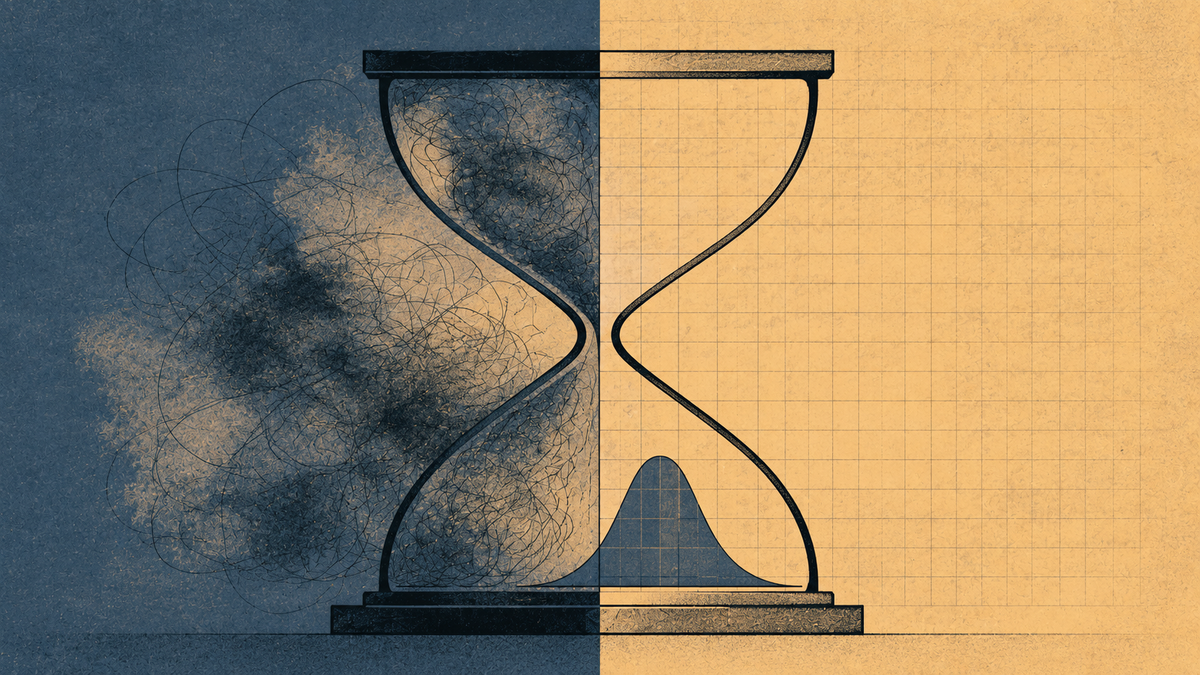
Somewhere in the self-help canon, a question became a framework. It goes like this: imagine yourself at 80, looking back. Which choice would you regret more? Now pick that one.
The Regret Minimization Framework — as it's been branded and recycled across podcasts, career coaches, and founder retrospectives — feels like wisdom. It's emotionally resonant, cuts through short-term noise, and sounds rigorous enough to justify a major decision. There's just one problem: it doesn't actually calculate anything.
What the regret test does
The test is a narrative reframe. It asks you to swap one emotional state (the anxiety of an imminent choice) for a different one (the imagined feeling of a future regret). This can be useful for breaking through analysis paralysis or clarifying values you weren't consciously aware of. It's a reasonable introspective prompt.
But it's not a decision tool. It assigns no probabilities to outcomes. It doesn't weigh magnitudes — how bad is the downside? how likely is the upside? It doesn't account for how often people in your situation actually succeed. It just asks: which story do you want to be able to tell?
That question is about narrative. Decisions are about outcomes.
The survivorship problem is baked in
When you imagine your 80-year-old self, which version of the story comes to mind? Almost certainly the one where the gamble worked. The startup found product-market fit. The leap paid off. You're not imagining the median outcome — you're imagining the story that would feel worth telling.
This is the same problem as taking career advice from successful people: the population giving the advice is selected from the tail of the distribution, not the middle of it. If 200 people made the same leap you're considering, maybe 15 have the retrospective you're imagining. The other 185 quietly went back to employment and don't headline podcasts about regret minimization.
The 80-year-old test visualizes the success path. It doesn't show you what most people in your situation actually experienced.
The invisible buffer
There's a structural assumption hiding inside the regret test that almost never gets named: it works best when failure is survivable.
"You can always recover from trying and failing" is true for some people, in some situations, under some conditions. It is not universally true. Whether you have six months of savings or six weeks, whether failure means a career gap or losing a home, whether you have dependents or don't — these variables aren't in the framework. The regret test treats every situation as if the downside is recoverable, because it was designed by and for people for whom the downside was recoverable.
If your situation includes constraints that RMF doesn't model, it's giving you advice calibrated for someone in a different situation.
What expected value actually means
Expected value — the alternative — sounds like a finance term but the idea is simple: multiply each possible outcome by how likely it is, and add them up. Do this across all your scenarios and you get a number that accounts for both probability and magnitude.
The important part isn't the formula. It's the discipline of stating your assumptions. What's your actual estimate that this works? Not the imagined-success version, but the honest base rate: how often do people in your specific situation, with your specific resources, pull this off? What happens if it doesn't work? How bad is that, concretely?
This is harder than imagining your 80-year-old self. It's also more honest.
What 1,000 simulations tell you
The regret test runs one scenario: the one where it works out. A Monte Carlo simulation runs a thousand — distributed across the full range of outcomes, weighted by probability.
Instead of asking which story would I want to tell?, you ask: if 1,000 people in my exact situation made this choice, what does the distribution of outcomes look like? What's the median? What's the 10th percentile? What's the probability of the outcome I'm afraid of?
That's not the same as the imagined future self. It's the actual population of futures, mapped.
The regret test gives you one emotionally compelling data point. Simulation gives you the shape of the whole thing.
Your 80-year-old self can't tell you what the distribution looks like. LifeOdds can.